
Most jewelry organizers are bought on looks. A white tree stand or a mirrored wooden box photographs beautifully, and the purchase feels done. Three weeks later the necklaces are tangled again, the earrings have migrated back to a saucer on the dresser, and the organizer is holding up a single bracelet.
The gap is almost always a mismatch between what the piece can hold and what you actually own. The seven checks below take about ten minutes, and they will save you more than the price of the organizer.
1. Count what you own, by type
Pull everything out and sort it into five piles: necklaces, earrings, bracelets and watches, rings, and “everything else” (brooches, hair clips, loose chains). Write the numbers down. Earrings are the pile people underestimate; a collection of 25 pairs is ordinary, and studs need a very different home from hoops.
Now read product specs as numbers, not adjectives. “Large capacity” means nothing. “13 necklace hooks, 7 bracelet hooks, 35 ring slots and 56 pairs of earring holes” means something, and that is exactly how the wall-mounted 5-in-1 organizer is described. If your necklace pile is bigger than the hook count, keep looking.
2. Decide where it will live
The location decides the format more than taste does.
| Format | Where it works | Where it fails |
|---|---|---|
| Wall-mounted organizer | Closet door, bedroom wall, small apartments with no spare dresser space | Rentals where you cannot drill (use adhesive-rated hooks and check the weight) |
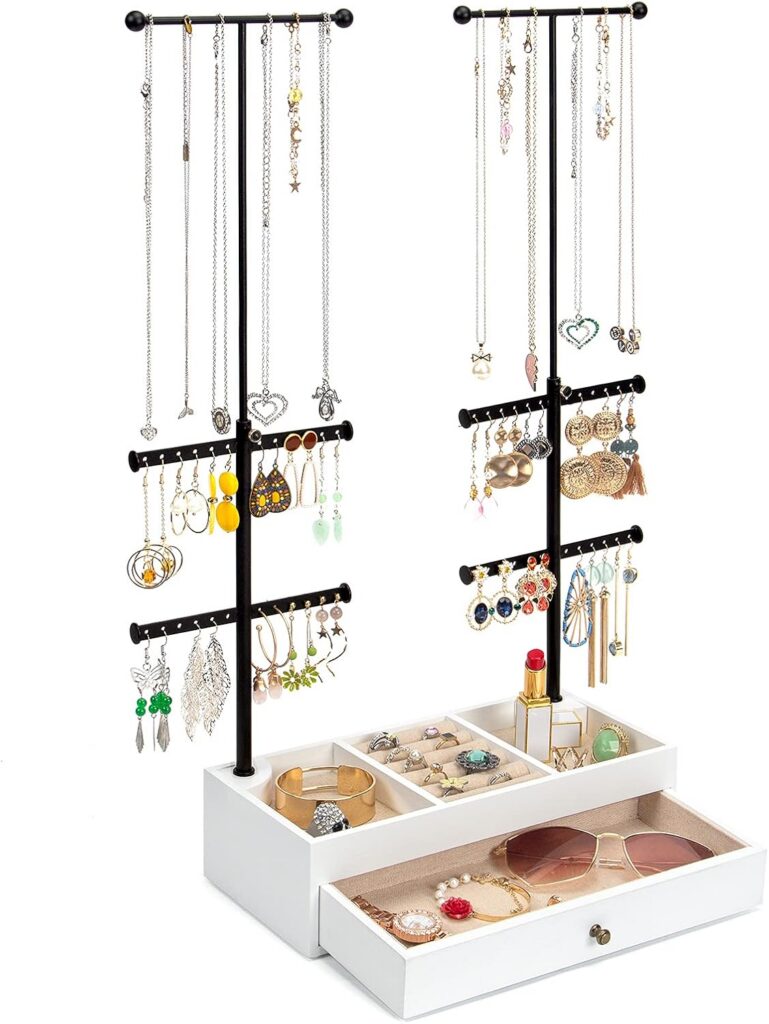
| Tabletop stand or “tree” | Vanity or dresser with at least a dinner-plate of free space | Crowded surfaces; tall stands tip when bumped |
| Lidded box with drawers | Pieces you want hidden and dust-free; gifts | Daily-wear pieces you want to grab fast |
| Drawer inserts | Existing dressers with shallow top drawers | Anyone who likes to see their collection |
Our own catalog covers the first three formats, from about $26 for a stand or wall unit to $45 to $67 for the larger lidded boxes. The difference in price is mostly about drawers and wood, not about how well it keeps necklaces untangled.
3. Match the necklace system to your longest chain
This is where cheap organizers fail. Hooks or bars that are too short let a 30-inch chain pool on the surface below, where it knots around anything beside it. Before buying, measure your longest necklace from clasp to pendant bottom and compare it to the vertical drop the organizer offers.
Rules of thumb that hold up in practice:
- Under 18 inches (chokers, collars): almost any hook or bar works.
- 18 to 24 inches: you need at least that much clear vertical drop, or a bar with a slight curve.
- 30 inches and up (long pendants, layering chains): wall-mounted units or tall tree stands only. Lidded boxes force you to coil them, which defeats the purpose.
A tree stand with two rods, such as the vintage white jewelry tree, solves this by giving long chains a full pole to hang from while a drawer box underneath handles the small stuff.
4. Check the earring system, not just the count
Earring storage comes in three types, and each suits a different collection:
- Hole boards and perforated panels. Best for studs and small hooks. Posts hold their pair together. Poor for chandeliers.
- Rotating racks. Good for dangle earrings and quick browsing, but they take up wall or tabletop room.
- Clear-window displays. Good for seeing everything at once, as on boxes that show up to 96 pairs through the lid.
If your collection is mostly studs, the number of holes matters more than the finish. If it is mostly dangles, count hooks, not holes.
5. Look at the lining and the wood
Soft linings protect plated jewelry from scratches, so velvet or felt in drawers and ring slots is worth paying for. On the exterior, there is a real material difference to know about:
- Solid wood is heavier, ages well, and can take a refinish. It is also the one you should check for humidity swelling if you keep it in a bathroom.
- MDF with a faux-leather wrap costs less, resists cracking and warping, and needs no polishing. It dents more easily if knocked.
Neither is wrong. A 4-tier faux leather box with a mirror at around $23 is a perfectly good starter for a modest collection; a solid wood piece makes sense when you intend to keep it for a decade.
6. Measure the footprint twice
Listings often give dimensions in a bullet nobody reads. Check width and depth against the surface where it will sit, and add an inch of clearance on each side so doors and drawers can open. For stands, check the base diameter against the height: a tall, narrow base is the one that falls over.
For example, a 6-tier wooden box measures roughly 10.5 inches wide by 6.5 inches deep and 12.5 inches high. That is a small footprint for what it holds, but it needs front and side clearance for the two swing-out doors.
7. Think about daily wear versus occasional pieces
The best setups split jewelry by how often you wear it. Daily pieces, such as a watch, two necklaces and a pair of studs, should sit somewhere visible and quick, like a stand, a wall panel or an open tray. Occasional and valuable pieces go behind a lid or in a drawer. An organizer that forces you to open three drawers each morning will lose to the saucer on the dresser every time.
Two things people ask
Is a bigger organizer always better?
No. An organizer that is mostly empty looks neglected and takes up room you could use. Buy for what you own now, plus about a quarter more.
Can I mix formats?
Yes, and most people end up doing it. A small stand for daily pieces and a lidded box for the rest is a common pairing, because each does what the other cannot.
A short checklist before you click Buy
- Do the hook, slot and hole counts match your sorted piles?
- Does the vertical drop beat your longest necklace?
- Is the footprint right with clearance for doors and drawers?
- Is there a soft lining where metal touches metal?
- Can you reach your daily pieces without opening anything?
If you answered yes to all five, you are probably buying the right one. To compare formats side by side, browse our jewelry organizers, which are sorted by type so you can go straight to wall units, stands or boxes.