
A wall mirror is the cheapest way to change a room. It bounces light around, makes a narrow hallway feel wider and fills a bare wall without the fuss of framing art. It is also easy to get wrong, usually because of one detail the product page does not stress: how big the mirror actually is.
Read the size twice: frame versus glass
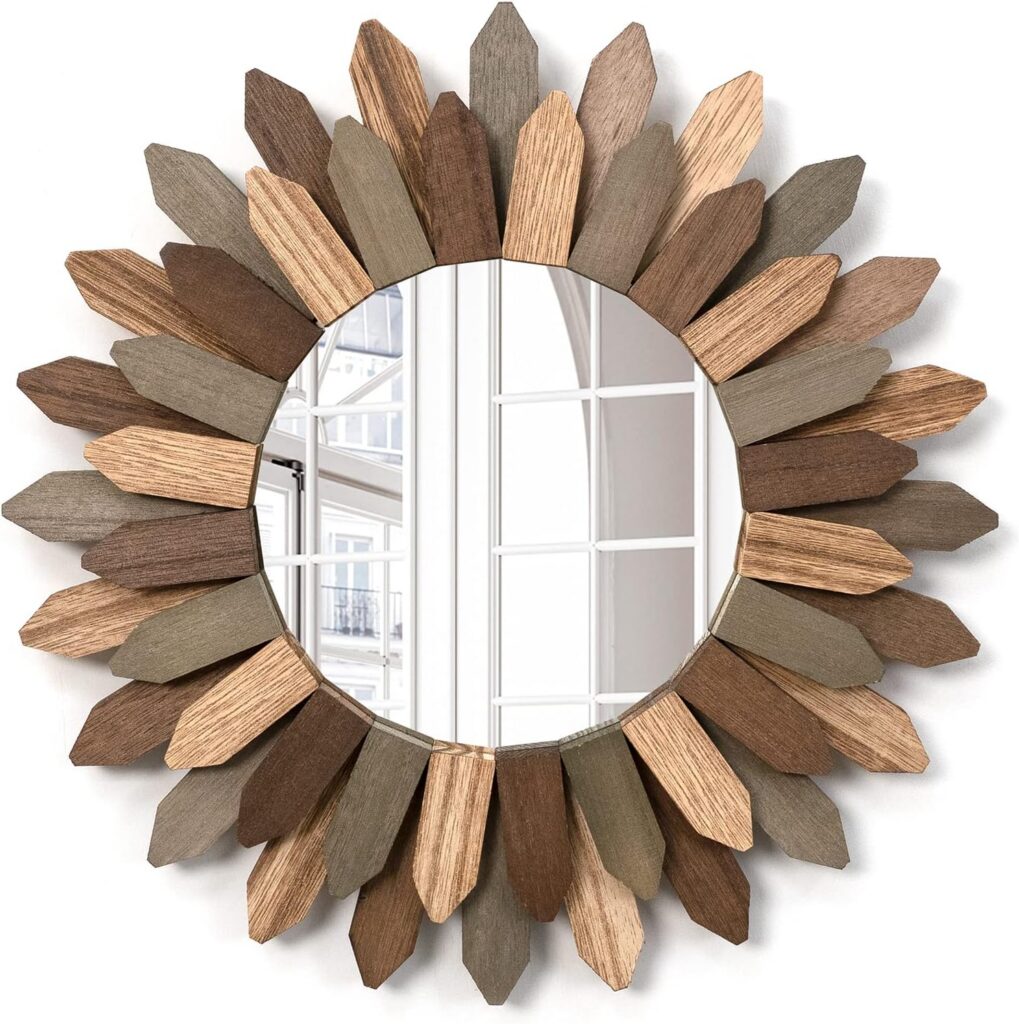
This is the single most useful thing in this guide. Sunburst and starburst mirrors are sold by the outside diameter of the frame, not the diameter of the mirror. The wood rays take up most of that width.
One example from our catalog: a 12-inch sunburst piece has a mirror about 5.9 inches across. It is a lovely accent, but it is not a mirror you can check your hair in. If you want to actually see yourself, look for a design where the glass takes up more of the total, or choose a larger frame.
So when you shop, find the two numbers:
- Overall diameter: how much wall space it covers.
- Glass diameter: how much of that you can actually see in.
If a listing gives only one, assume it is the overall size.
Which size works where
| Space | Good size | Why |
|---|---|---|
| Above a small console or nightstand | 12 inches | Accent scale, will not crowd the wall |
| Entryway or hallway | 18 inches | Reads as a real mirror, though a sunburst this size has under 8 inches of glass |
| Above a dresser or fireplace | 24 inches and up | Needs presence to look intentional |
| Bathroom | Rectangular with a shelf | Practical, doubles as storage |
The round boho sunburst mirror comes in 12, 18 and 24 inches, starting around $21, so you can pick the scale that fits.
Frame finish and style
The finish does most of the styling work.
- Torched, dark wood: a carbonized look that suits farmhouse, boho and rustic rooms. It hides dust and fingerprints.
- Natural or light wood: brighter, better for modern or Scandinavian rooms.
- Weathered white: soft and relaxed, a good fit for bathrooms and cottage decor.
A boho sunburst mirror in a rustic wood frame in torched wood brown works as a sculptural piece on a plain wall. In a bathroom, a rectangle with a shelf is the more practical choice: the 20 by 16 inch farmhouse mirror with a shelf gives you a place to put a toothbrush cup, a candle or a small plant.
Round, rectangular or arched?
Round mirrors are forgiving. They soften a room full of right angles, and they look right on almost any wall. That is why the sunburst round is so popular in boho and farmhouse rooms: the shape does the decorating for you.
Rectangles are better when you need to see more of yourself. A tall, narrow mirror shows you head to toe, and a wide, low one works over a dresser or vanity.
Arches give a softer, more architectural look and suit entryways, but they take more care to hang straight. If you want that shape in a big size, be prepared to find a stud.
What to look for in the build
A few quality checks are visible even in a product listing.
- Real wood or composite? Solid wood frames are heavier, and they take on a warm, uneven grain, particularly with a torched finish. Composite frames are lighter and cheaper but can feel flat.
- Glass or acrylic? Glass gives a true reflection. Acrylic mirrors distort slightly at the edges and scratch more easily, so check which one the listing means before you buy.
- Hanging hardware. A good mirror ships with a sturdy hanger already attached. If the listing says nothing about it, you will have to improvise.
- Edge finishing. Look at customer photos if any are posted. Clean edges and a well-fitted glass are the sign of a well-made piece.
Where to put it
Placement changes how a mirror behaves.
- Opposite a window. It doubles the daylight and makes the room feel brighter. Keep it off the wall that gets harsh afternoon glare.
- At the end of a hallway. It adds depth and makes the passage feel longer.
- Above a console. The classic entryway spot. Hang it so the bottom edge sits 6 to 8 inches above the surface.
- Beside a bed, not across from it. Many people find a mirror facing the bed unsettling at night.
Centering matters too. The middle of the mirror should land about 57 to 60 inches from the floor, which is average eye level, unless the mirror is above a piece of furniture. In that case, the furniture decides the height.
Hanging it safely
Mirrors are heavier than they look, and glass shatters, so hang with care.
- Weigh it or check the listing, then pick hardware rated for at least twice that weight.
- Use a stud or a drywall anchor for anything larger than the smallest sizes.
- Check the back. Most wood mirrors have a sawtooth hanger or wire. Make sure the hanger is firmly attached before you lift it onto the wall.
- Level it with a small level or a phone app. A tilted circle is harder to spot than a tilted rectangle, so look at the frame details.
For a renter, picture-hanging strips rated for the weight are an option on smaller mirrors, but follow the weight limit exactly.
Cleaning
Spray glass cleaner onto a cloth, not onto the mirror. Spray running down behind the frame can stain the back or loosen the adhesive, and it can warp wood. Wipe the wood frame with a dry cloth.
Pairing a mirror with other decor
A mirror pairs well with a matching wall clock in the same finish, and a cluster of two or three round pieces at different sizes creates a casual gallery wall. Keep the finish consistent and vary the size.
Quick checklist
- Check the glass diameter, not just the frame.
- Match the scale to the wall: small for accents, large for a focal point.
- Pick a finish that suits the room.
- Use proper anchors and hang it at the right height.
When you are ready to compare styles and sizes, our wall mirrors collection lists every frame.